

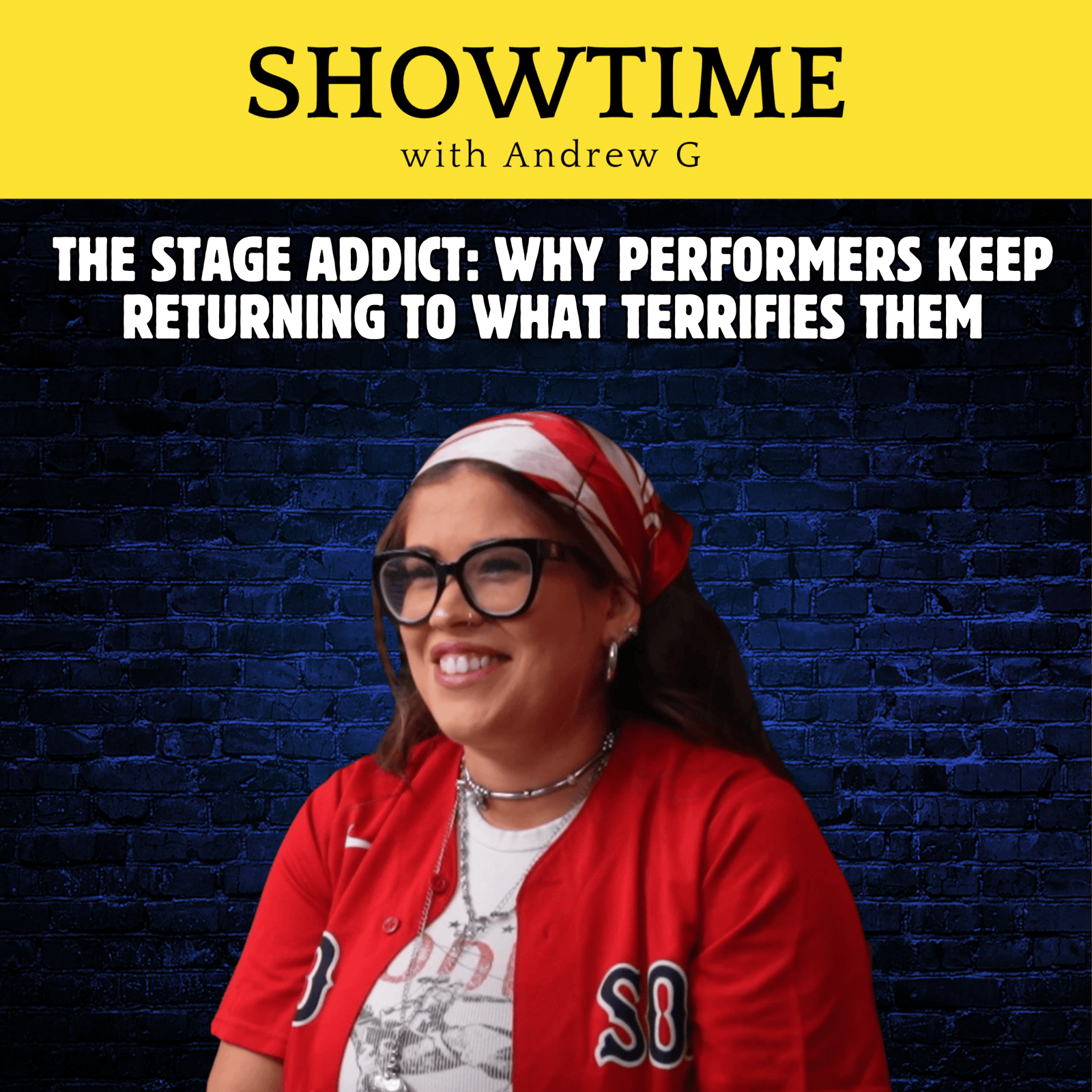
Every so often, a conversation about performance moves beyond scripts, cues, and stagecraft, and becomes something far more human. In a recent episode of Showtime, Andrew G speaks with performer, writer, and creator Olivia Mitchell—an artist who spends her evenings stepping into other people’s lives on stage while quietly building stories of her own. What emerges is not just a discussion about acting, but a reflection on nerves, creativity, storytelling, and the undeniable pull that keeps performers returning to live theatre, despite everything that might push them away.
The reality of stepping onto a stage is rarely what people expect. Ask any performer what they feel in the moments before the curtain rises, and “confidence” is unlikely to be the first word they reach for. Olivia describes it more truthfully as a blend of anxiety and excitement, a peculiar mix that makes you feel like you could bolt for the exit and run towards the spotlight at the same time. It’s not a contradiction performers try to resolve—it’s something they learn to live with. Fear and exhilaration coexist, feeding into each other in a way that becomes strangely addictive over time.
And yet, despite those nerves, performers keep coming back. The reason lies in what happens next. As soon as the performance begins, something shifts. The anticipation gives way to focus, the performer dissolves into the character, and the story starts to breathe in front of a live audience. When everything aligns, the experience becomes electric. It’s a feeling that’s difficult to replicate anywhere else, and perhaps impossible to fully explain to anyone who hasn’t stood in that space themselves.
There’s also a persistent misconception that acting is simple. From the outside, it can look like little more than memorising lines and standing in the right place. Olivia finds that idea quietly amusing, because the reality couldn’t be further from the truth. Building a character requires constructing an entire human being from the ground up. It involves understanding how that person thinks, how they move through the world, what shapes their decisions, and how they connect with others. Every gesture, pause, and line delivery carries intention. Actors are not simply reciting words; they are creating lives and attempting to make them believable, even if only for a couple of hours.
Part of what makes theatre so compelling is that it never exists in isolation. Unlike film or television, where the final product is fixed, theatre is influenced by the people watching it. Each audience brings its own energy into the room. Some respond with laughter and audible reactions, while others sit in quiet stillness, absorbing every moment. Regardless of how that energy manifests, performers feel it instantly. There’s an unspoken exchange between stage and seats, a subtle feedback loop that shapes the rhythm and tone of the performance. No two shows are ever exactly the same, and that unpredictability is part of the magic.
For Olivia, the journey into storytelling didn’t begin with professional theatre. Like many creatives, it started much earlier, with a natural curiosity about the world and a desire to capture it. As a child, she imagined becoming an author, constantly writing, observing, and collecting ideas without necessarily knowing what they would become. That instinct hasn’t faded. Inspiration still arrives in unexpected ways—a passing conversation, a fleeting moment, a line of dialogue that sparks something larger. Sometimes those ideas sit quietly for years before they find their way into a script. But when they do, there’s a unique satisfaction in seeing something that once existed only in your mind take shape in front of an audience.
There is, however, an added layer of vulnerability when performing your own work. Stepping into a role is one thing; presenting something you’ve written yourself is another entirely. When the story, characters, and words are yours, the stakes feel higher. It’s no longer just about delivering a performance—it’s about whether the audience connects with the story at all. That exposure can be confronting, but it also becomes part of the creative process. Each performance offers feedback, whether subtle or obvious, and provides an opportunity to refine and reshape the work. Creativity rarely arrives fully formed, and theatre allows it to evolve in real time.
In her current work, Olivia is performing in a production of The Tempest, but not within the confines of a traditional theatre. Instead, the show unfolds outdoors, across gardens, coastlines, and open spaces throughout Victoria. This shift in environment transforms the experience entirely. Without the barriers of walls and artificial lighting, the audience feels closer to the action, and the natural surroundings become part of the storytelling. The landscape itself adds texture and atmosphere, enhancing the sense of immersion.
This approach also changes how audiences engage with the material. Shakespeare, for many, can feel intimidating on the page—dense, unfamiliar, and difficult to interpret. But when performed live, especially in an open and accessible setting, the language takes on a new clarity. It becomes expressive, often humorous, and deeply human. Stories written centuries ago suddenly feel relevant, their themes echoing in ways that resonate with modern audiences.
In a world dominated by streaming platforms and on-demand content, it’s easy to question where live theatre fits. With endless entertainment available at the touch of a screen, theatre might seem outdated. But its value lies precisely in what technology cannot replicate. When people gather in the same space to witness a story unfolding in real time, something distinct occurs. There is a shared presence, a collective experience that can’t be paused, rewound, or replicated. It exists only in that moment, for those who are there to witness it.
For performers like Olivia, the path is not always straightforward. There are moments of doubt, questions about sustainability, and the constant challenge of navigating a creative career. These uncertainties are common across the arts. Yet, despite them, the pull of storytelling remains strong. The chance to step into a character, to connect with an audience, and to be part of something immediate and real continues to draw artists back.
It’s not always logical, and it’s rarely easy. But it is deeply fulfilling. At its core, theatre is built on something simple and timeless: a group of people coming together, a story unfolding before them, and a shared emotional experience that lingers long after the lights have gone down.
