

There’s something oddly comforting about hearing a comedian admit they have no idea why they keep doing it. Not in a careless way—but in a way that feels honest. Because sometimes, the things that matter most don’t come with clean explanations.
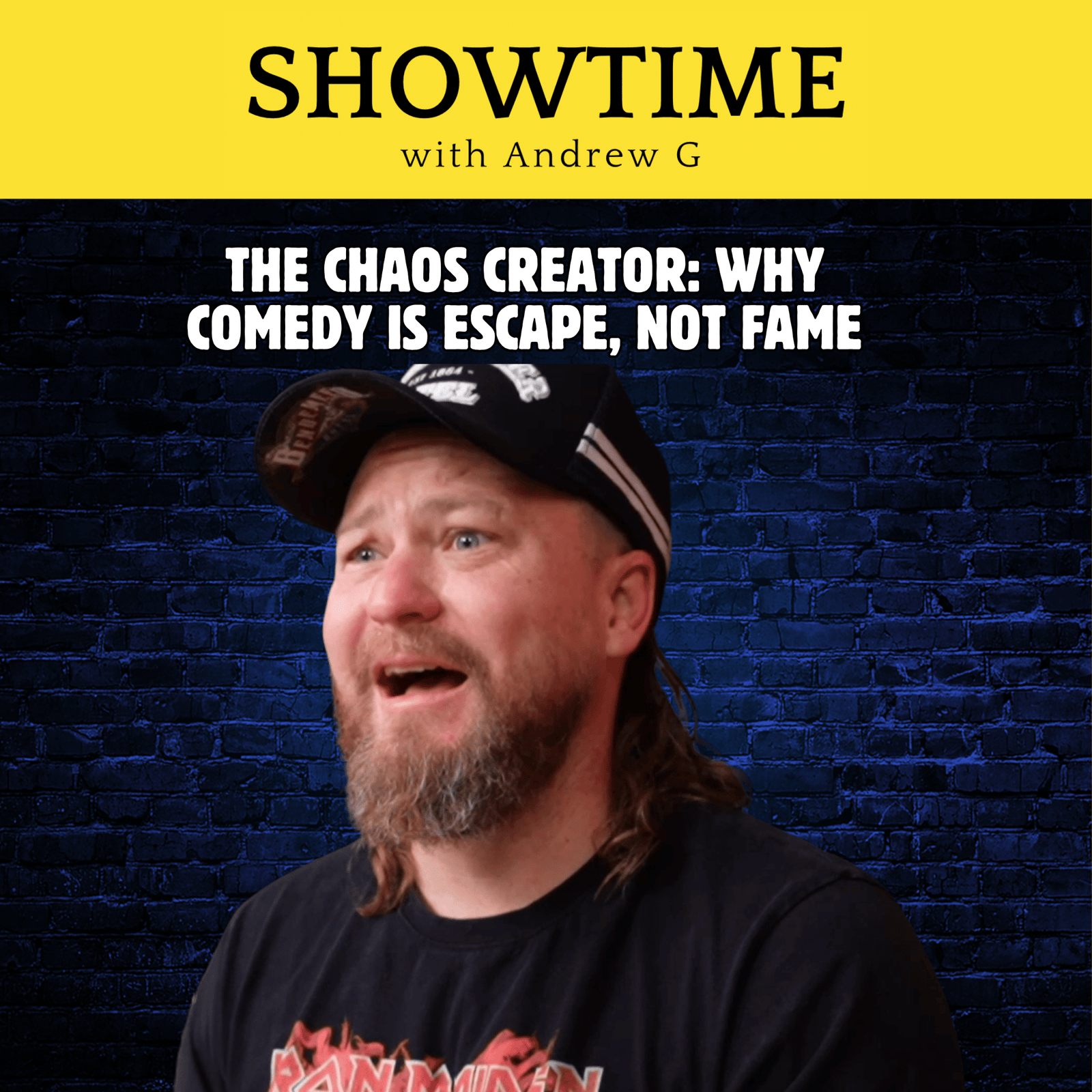
In this episode of Showtime, Andrew G sits down with Brett Blake — a fast-rising Australian comedian known for his raw, fearless style. But what unfolds isn’t just about stand-up or success. It’s about the deeper pull behind performing, and why some people keep coming back to it, even when it’s hard, unpredictable, and at times, brutally humbling.
Because comedy, at its core, isn’t just about being funny.
It’s about connection. It’s about release. And for Brett, it’s always been a way to make sense of the world.
He talks about comedy like it’s a kind of escape—not just for the audience, but for himself. A small room, a handful of people, a shared moment where, for a while, everything else fades into the background. The noise of the world, the stress, the pressure—it all softens, even if just for a few minutes.
And that feeling? That’s what keeps him going.
Not fame. Not recognition. Just the simple, powerful reaction of making someone laugh.
But what makes his story more compelling is where it started. Brett didn’t grow up as the obvious “funniest person in the room.” He wasn’t the standout. He was somewhere in the mix—confident, a bit of a smartass, but not necessarily the one everyone expected to end up on stage.
School, in particular, was tough. Struggling with ADHD and dyslexia, he found himself constantly out of sync with the system around him. While other kids seemed to move through lessons with ease, he felt stuck—confused, frustrated, and often misunderstood. And like many people in that position, he found his own way of coping.
Humour.
Not as a calculated skill, but as a way to shift attention, to disrupt the moment, to feel some level of control in an environment where he had very little. Making people laugh became a way to belong, even if it started as a way to survive.
And somewhere along the way, that instinct turned into something more.
There’s a moment he recalls—simple, almost accidental—where he made an entire classroom laugh. Nothing polished, nothing intentional. Just a reaction. But it stuck. That sound, that shared response, became something he would chase long after he left school.
It’s interesting, because when people think about comedy, they often imagine natural talent. A gift. Something you either have or you don’t. But Brett’s experience tells a different story.
It’s built on trial and error. On bombing. On trying something that doesn’t work, and then going back out and trying again.
He speaks openly about rejection—not just in the industry, but on stage, in real time. Jokes that fall flat. Sets that don’t land. Moments where the silence is louder than any laugh. And yet, instead of avoiding those experiences, they become part of the process.
Because in comedy, failure isn’t the exception. It’s the work.
Every joke starts rough. Every set is shaped by audience reactions. There’s no shortcut to knowing what works—you have to stand in front of people and find out.
And that’s where something deeper starts to reveal itself.
Comedy isn’t just about writing punchlines. It’s about observing people. The way they speak, react, behave. The small, specific details that make someone feel real. Brett draws heavily from this—blending different personalities, moments, and experiences into characters that feel instantly familiar.
Not because they’re exact replicas of real people, but because they capture something true.
That’s what makes audiences connect. Not perfection, but recognition.
And like any creative path, there’s no clear trajectory. Brett talks about feeling like he was on the outside looking in—watching others get opportunities, wondering when or if his moment would come. Years of being “in the mix,” but not quite breaking through.
It’s a feeling a lot of creatives know well.
That space between effort and outcome, where nothing feels guaranteed.
But instead of walking away, he kept going. Kept performing. Kept refining. Kept showing up.
And eventually, things shifted. Not overnight, not all at once—but enough to change direction. A show that resonated. More people paying attention. Opportunities that started to open.
Still, even now, there’s an awareness that success isn’t always linear—or fair. That there are incredibly talented people who don’t get the same chances. That timing, luck, and circumstance play a bigger role than most people like to admit.
And maybe that’s part of what keeps it grounded.
Because when you strip everything back, the reason for doing it hasn’t changed.
It still comes down to that moment on stage.
A room full of people. A shared experience. A reaction you can’t predict or replicate.
There’s something uniquely powerful about live performance. You can’t pause it. You can’t edit it. It exists only in that moment, between the performer and the audience. And anything can happen.
That unpredictability—the possibility of things going wrong, or unexpectedly right—is what makes it real.
It’s also what makes it meaningful.
Because when a joke lands, when a story connects, when a room full of strangers laughs together, there’s a kind of alignment that’s hard to describe. Brief, fleeting, but enough to remind you why you keep coming back.
And maybe that’s the thread running through everything.
Not just comedy, but creativity as a whole.
It’s not about having it all figured out. It’s not about always succeeding.
It’s about showing up anyway.
Taking the risk. Embracing the uncertainty. Being willing to fail in front of people, and still choosing to step back on stage.
Because every now and then, something clicks.
A laugh. A moment. A connection.
And for a brief second, everything makes sense.
