

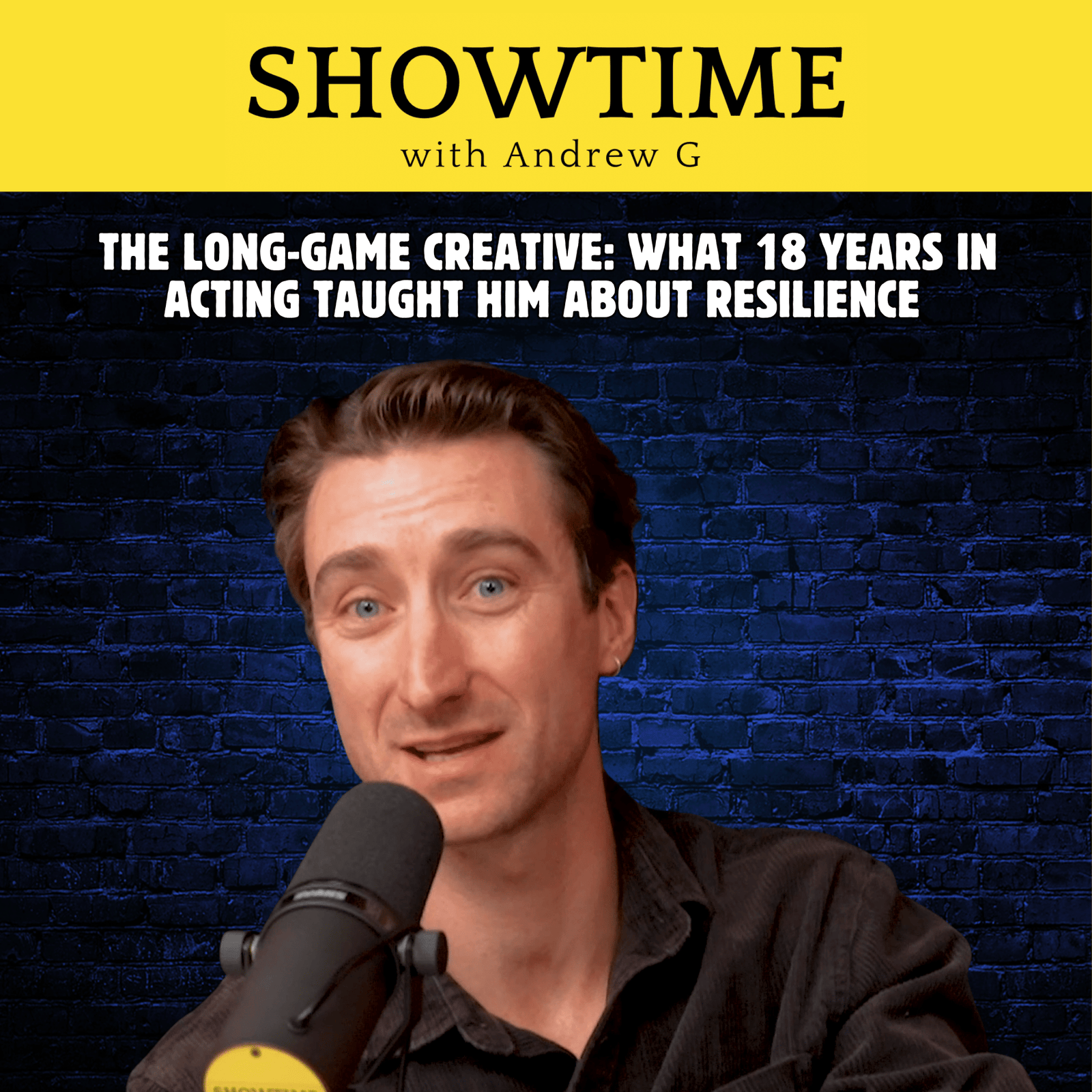
There is something inspiring about hearing from someone who has dedicated their life to a craft despite uncertainty, rejection, and the constant pressure to prove themselves. For actor Tom Stokes, a career in theatre, film, and television has never been about chasing fame or recognition. Instead, it has been driven by a genuine love of storytelling, a commitment to creative growth, and a willingness to keep showing up, even when success is far from guaranteed.
In this episode of Showtime, Andrew G sits down with Tom to explore the realities of building a sustainable career in the performing arts. What unfolds is an honest conversation about passion, resilience, rejection, and the lessons that come from pursuing a dream without a backup plan.
Tom’s journey into acting began much earlier than he realised. As a young child growing up in Perth, he discovered that he loved being in front of an audience. What started as speech and drama lessons to help overcome shyness gradually became the place where he found confidence, connection, and a sense of belonging. While many of his peers found their identity through sport or other pursuits, drama became the environment where he felt most at home.
As he progressed through school, a teacher recognised his potential and encouraged him to consider acting as more than just a hobby. That support, combined with encouragement from his family, helped him begin to imagine a future in the arts. Unlike many aspiring performers, Tom never developed a serious Plan B. While he explored other creative interests during university, including film studies, he always found himself drawn back to performance. It was the one thing that consistently felt right.
The conversation highlights the uncertainty that accompanies almost every creative career. After graduating from drama school, Tom experienced a period that many young actors know all too well. Despite years of training and preparation, opportunities did not immediately arrive. He recalls leaving his showcase feeling as though his career may have stalled before it had even begun. The silence from agents and casting directors was confronting, and for a time he felt as though he was constantly trying to catch up.
Yet rather than walking away, he persisted. Looking back, Tom credits much of his longevity to patience and consistency rather than any single breakthrough moment. He speaks openly about the importance of staying the course, even during periods when work feels scarce and self-doubt becomes difficult to ignore. It is a perspective that has been shaped by nearly two decades in the industry and countless experiences of hearing the word “no.”
Rejection emerges as one of the central themes of the discussion. Tom reflects on how actors spend much of their careers auditioning for opportunities they may never receive. While the sting of disappointment never completely disappears, he has learned not to view rejection as a judgement of his worth. Sometimes another actor is simply a better fit. Sometimes decisions are influenced by factors beyond anyone’s control. And occasionally, opportunities that seem destined to happen disappear entirely at the last moment.
One particularly memorable story involves a television role that Tom desperately wanted. After investing significant time and emotional energy into the audition process, he ultimately missed out. At the time, the disappointment felt devastating. Yet only weeks later, that rejection created space for an entirely different opportunity—his first international feature film. The experience became a powerful reminder that career setbacks are often impossible to fully understand in the moment. What feels like a closed door today may ultimately lead somewhere far more significant tomorrow.
The discussion also turns to Tom’s latest project, Anna X, a contemporary stage production inspired by the real-life story of Anna Delvey. The play examines ambition, identity, social status, and the increasingly blurred line between reality and performance in the digital age. Through the lens of one of the most notorious social media-driven scams of recent years, the story raises important questions about authenticity, influence, and the lengths people are willing to go in order to be seen.
For Tom, one of the most fascinating aspects of the play is its exploration of perception. Anna Delvey constructed an image of wealth and success through carefully curated appearances and social media presence, convincing influential people that she belonged in elite circles. The story feels particularly relevant in an era where personal branding often carries as much weight as genuine achievement. As Tom points out, social media has become a powerful tool for shaping identity, sometimes making it difficult to distinguish between who people truly are and who they want the world to believe they are.
Beyond its commentary on social media, Anna X also explores broader themes of class, privilege, and power. The play challenges audiences to consider why some people are punished for bending the rules while others seem able to benefit from the same systems without consequence. These questions resonate far beyond the theatre and connect directly to conversations taking place across society today.
Throughout the interview, what becomes clear is that Tom’s career has been built on more than talent alone. It has required persistence, adaptability, and an acceptance that uncertainty is part of the process. Whether discussing the highs of landing a major role or the lows of missing out on one, he approaches each experience with a perspective that has been earned through years of navigating an unpredictable industry.
By the end of the conversation, Tom offers something that extends well beyond acting. His story serves as a reminder that success is rarely linear, that rejection is not always a dead end, and that meaningful careers are often built through perseverance rather than immediate achievement. In a culture that frequently celebrates overnight success, his journey highlights the value of patience, resilience, and trusting the process.
Ultimately, this episode is about finding fulfilment in the work itself, embracing uncertainty, and understanding that sometimes the opportunities that shape us most are the ones we never saw coming.
