

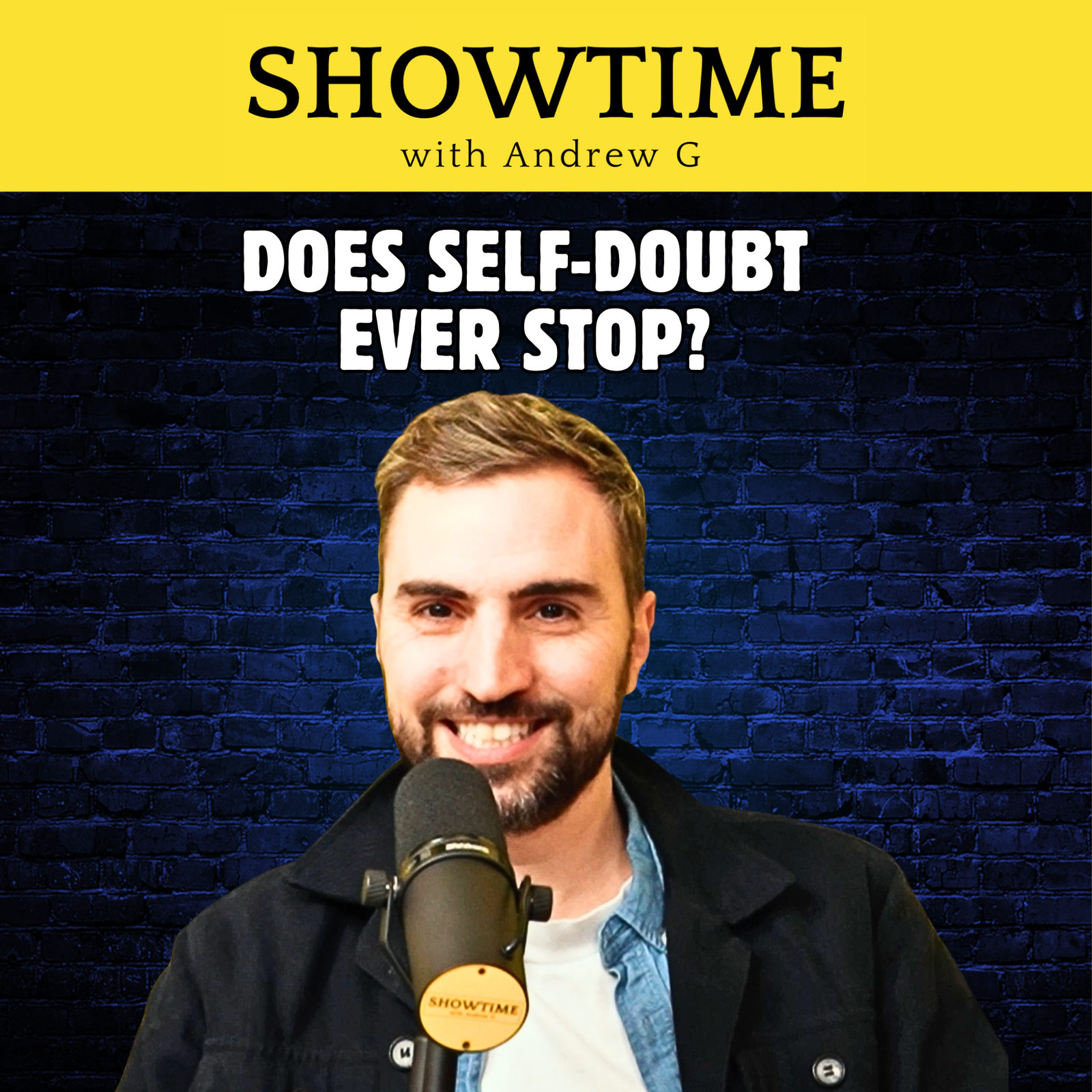
At 24, Simon Taylor was writing jokes for one of the biggest names in American television. Two decades and more than 20,000 jokes later, he’s still talking himself into believing it actually happened. That contradiction — extraordinary achievement paired with stubborn self-doubt — runs through the whole of this episode of Showtime, recorded ahead of the release of Simon’s new satirical comedy series, The Sonny Disposition.
Simon’s path to Jay Leno’s writers’ room started, fittingly, with a discipline most people would call a bad habit: posting dozens of jokes a day on Twitter. Back when the platform was capped at 140 characters and built almost entirely around text, Simon treated it as a training ground, setting himself small daily goals — ten retweets, then keep going — until he’d spent two years sharpening the same muscle: saying the least amount possible to get the biggest laugh. When he eventually met Leno and got the chance to submit jokes, he already had the speed and precision built in. He sent two pages of jokes that first night. By the next day, he had a contract.
What followed was a genuinely staggering volume of work — writing as many as 50 jokes a day for two years, for a show where every joke went directly to Leno with no writers’ room buffer in between. Despite the scale of it, Simon is disarmingly honest about how little it changed his sense of himself. He came home to Australia and didn’t tell anyone for months, partly out of nerves, partly because he assumed he’d be fired quickly. When he finally told a comedian friend about the job, the response was blunt: “Yeah, but you’re still shit.” It’s a very Australian kind of humbling, and Simon says he still has to talk himself into confidence even now, reminding himself, essentially, that yes, this actually happened and yes, it actually mattered.
One of the clearest lessons from those years, he says, was learning not to be precious about any single joke — a principle he now applies to everything from sitcom scripts to a friend’s unpublished novel. If something isn’t working, you cut it, trust that there’s more where it came from, and keep moving. That instinct served him again years later, when Shaun Micallef, after two seasons of Simon writing for Mad As Hell, told him he shouldn’t be writing for someone else’s voice anymore — he should be on screen, doing his own thing. Simon describes it as one of the most positive rejections of his career: being pushed out of a room in order to go build his own.
That push eventually led to The Sonny Disposition, a satirical workplace comedy set inside the unregulated, high-stakes world of modern podcasting. Simon is unusually direct about why he wanted to make it: unlike legacy broadcast media, which spent decades building up ethics codes and regulatory oversight, podcasting largely operates without any of that scaffolding. Anyone can say almost anything to almost anyone, and if the audience keeps listening, there’s little stopping them. Rather than treat that as purely alarming, Simon uses the show to interrogate it — including an episode about a guest refusing to appear on a podcast because of its gambling sponsor, written and shot months before real podcasters began publicly grappling with the exact same issue.
The conversation also wanders into thornier territory: what authenticity even means anymore, in a media landscape stitched together by ghostwriters, editors, collaborators and, increasingly, AI. Simon pushes back on the idea that “authentic” content is ever as pure as audiences assume — pointing out that even a masterpiece like the Sistine Chapel ceiling involved far more hands than the single genius most people picture. His read is that people will always want a boutique, human-made alternative to mass-produced content, in the same way some diners will always seek out a chef using produce from a farmer they know personally, even as most of the world eats fast food without thinking twice.
Despite his frustration with being tied to platforms owned by tech giants he’d rather not enrich, Simon is pragmatic about the trade-off: build where the audience already is, while trying to nudge the industry toward something more community-focused and sustainable. Looking ahead, he’s less interested in chasing his own next opportunity than in creating them for others — particularly the generation of creators in their twenties who, he says, are often stuck waiting for someone to hand them a show, the way he once did, rather than being given the resources to simply go make one.
The Sonny Disposition premieres September 1 on Stan, 9Now, 9Go! and the Nine Network.
Follow SHOWTIME for weekly conversations with the people behind the curtain.
