
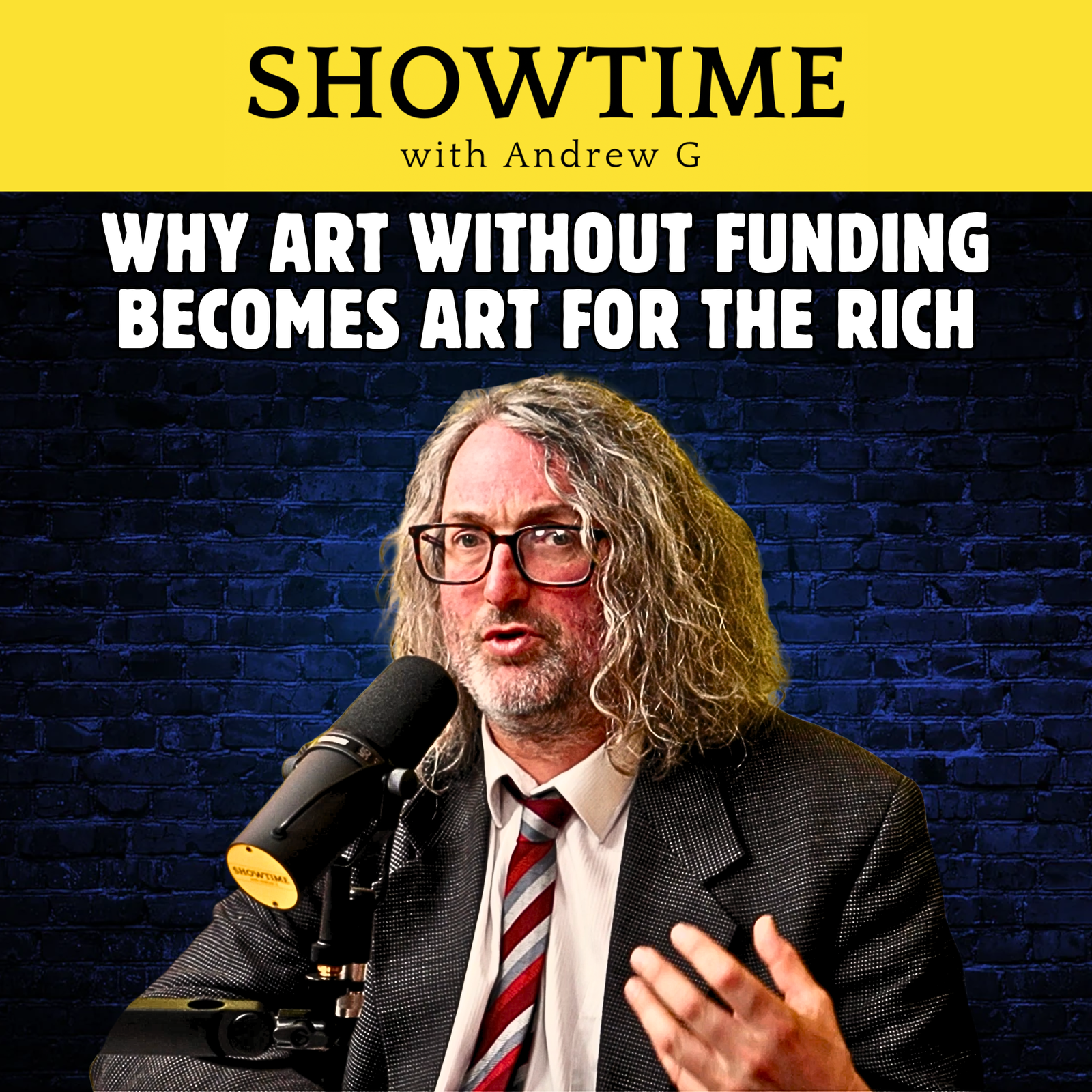
Melbourne likes to call itself Australia’s cultural capital, but Dr Ben Eltham isn’t sure how much longer it can. “I can’t remember a time in the last 30 years when the art scene in Melbourne has been in this much trouble,” he says. A journalist, researcher and Monash University lecturer whose analysis helped fuel the Don’t Break Our Arts campaign, Ben has spent years studying how governments fund culture. In this episode of Showtime, he sits down with Andrew G to talk about money, politics and what we stand to lose if we stop investing in creativity.
His route into the arts was an unusual one. Ben’s first degree was in cellular neuroscience, and he spent an honours year in a University of Queensland lab working on some very expensive microscopes. He loved it, but by the end he knew what he really wanted to do with his life was work in the arts. He started as a theatre critic and later worked in the Canberra Press Gallery, where seeing politicians up close taught him two things: many of them aren’t great with science or numbers, and they’re ordinary human beings with the same needs and wants as everyone else.
That science background still shapes how he talks about culture. When we listen to music, read a novel or sit through a play that moves us to joy, terror or catharsis, he says, it literally rearranges the neurons in our head. But for Ben, the value of the arts goes well beyond what it does for one person. It’s good for democracy, it helps us understand the people we meet, and it helps us make sense of the problems of the 21st century. What disappoints him is how often policymakers treat the arts as a little corner that people don’t really care about. “I actually don’t think that’s true,” he says. “I think people care a lot about the arts, and that’s why I’m campaigning.”
He knows firsthand how fragile the arts can be. Years ago, Ben ran a festival that went broke, and he still remembers watching the credit card bills rack up. Anyone who has put on a show knows the feeling of watching ticket sales come in one at a time and wondering if you’ll break even and be able to pay everyone. Asked who is hardest to get a straight answer from, he doesn’t pick politicians, who he says can be surprisingly honest off the record. It’s the arts bureaucrats, who face enormous need with very little money and are left saying they’d like to help if only they could.
Part of what has changed, he explains, is the platforms. Thirty years ago, a local band had Triple J, venues that paid them to play, record stores that sold their music and a touring circuit around the country. Most of that has vanished. Today one global streaming platform holds something like 70% of the Australian music listening market, and most of the money goes offshore, with only tiny royalties trickling back. When Andrew suggests streaming has given artists more ways to be heard, Ben disagrees: being on a platform guarantees nothing, because most listening goes to a small number of famous artists. Only a handful of Australian songs made the ARIA top 100 for 2025, and he says musicians and actors are now leaving Australia the way they did before Gough Whitlam transformed cultural policy in the 1970s. His fix is a local content quota for audio streaming. Prime-time TV already has a 55% local content rule, and video streamers now have their own requirements. He’d also like to see far more money go to community radio, though he admits a small conflict of interest as a semi-regular on Triple R.
Closer to home, the numbers are stark. Victorian funding for artists and small-to-medium organisations has fallen 35% in real terms over the last four or five state budgets. Abbotsford Convent has been defunded, Writers Victoria has lost all of its funding, and the small grants of $10,000 or $20,000 that help an artist record an album or write a play have been slashed. “Melbourne is supposedly a city of literature,” he says. “We went to the UN and said, ‘We’ve got lots of writers, make us a city of literature.’ And now we’re defunding the main body that supports writers in this state?” For the first time he can remember, artists are leaving Melbourne, some of them for Brisbane. What worries him most is the grassroots, the next generation coming up, and the mid-career artists in their 30s and 40s who have given 20 years to the arts and are now thinking about getting a day job just to pay the rent.
Andrew, who has produced theatre with no government money at all, puts a fair challenge to him: won’t art get made anyway? Ben agrees that it will, because making art is part of being human. But he compares it to healthcare. Take away public funding and you’d still have doctors, mostly for people who can afford them. Take away arts funding and you’d still have Hollywood blockbusters and commercial hits, but you’d lose the street-level culture, the experimental work and the places like La Mama and Back to Back where young artists get their start. History backs him up, he says. When Whitlam doubled federal arts funding, Australia got a cultural renaissance, a homegrown film industry and directors like Peter Weir. The arts create jobs too, from the stage crew in black T-shirts to the people rigging the lights, but Ben says that isn’t the main reason to fund them. Stories matter to us as voters and as citizens.
So why should taxes pay for theatre when hospitals and schools need money? Ben’s answer is that we can have both. He points out that the state government committed $45 million to bring three American NFL games to the MCG over four years. Restoring the arts cuts, by his estimate, would cost around $60 million in a state budget of close to $100 billion, less than one new train station. “That’s a rounding error,” he says.
The real difference, in his view, is organisation. When the AFL goes to Spring Street, it brings footballers and people in suits, and sporting codes are ruthless lobbyists. The arts sector has nothing like that, and it doesn’t yet know how to turn public goodwill into political pressure. He rejects the idea that audiences aren’t there, though. Australian Bureau of Statistics data shows more Australians engage with culture than with football, and more go out to live music than to the footy.
That’s why the campaign is taking to the streets. Ben points to 2010, when licensing changes threatened Melbourne’s live music venues and 20,000 people turned out on the steps of Parliament House for the SLAM rally. He believes Victorians will show up again, because when people have a little spare time and money after work, caring and putting the kids to bed, so many of them spend it going to gigs, watching shows, playing an instrument or reading a book.
Despite everything, he’s hopeful. Asked what excites him most right now, he names First Nations art, pointing to Archie Moore’s win at the Venice Biennale and the writer Evelyn Araluen, editor of Overland. Down the road from his home in western Victoria, there is rock art that may be 15,000 to 20,000 years old, older than the wheel and older than bread. “Art and culture is not going away,” he says. “One of the reasons we fight for it is because it is so important to what it is to be a human.”
The Don’t Break Our Arts rally is on Monday 9 November at 4:30pm on the steps of State Library Victoria. Find out more at dontbreakourarts.org.
Follow Andrew G: @AndrewGShowtime
Follow Showtime: @ShowtimePodcastAU
Subscribe to Showtime with Andrew G for weekly conversations with the people behind the curtain.