

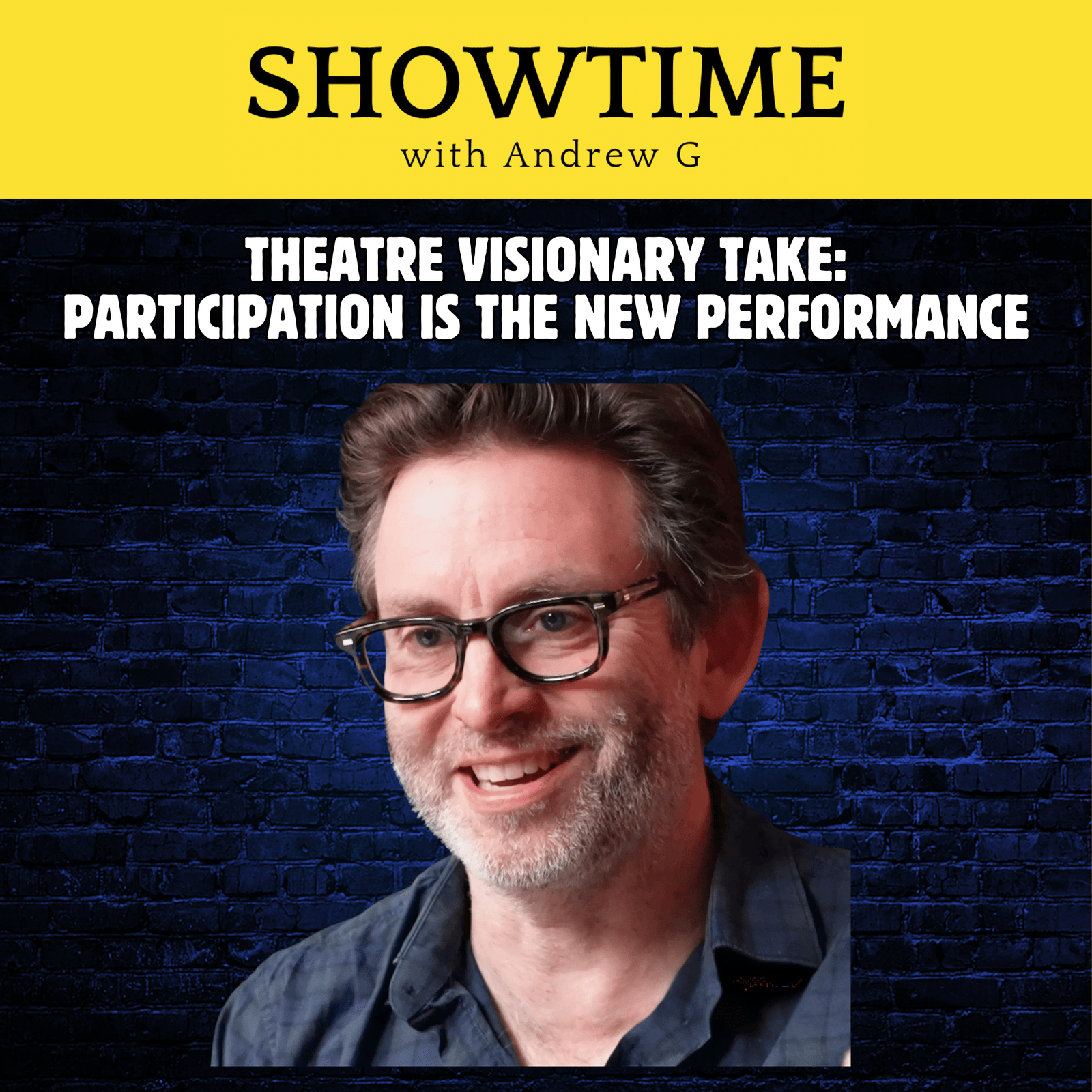
Every so often, a conversation about theatre drifts away from stages, lighting rigs, and ticket sales, and settles somewhere far more human. In a recent episode of Showtime, Andrew G sits down with arts leader and director Sam Strong, a figure known for reshaping major companies and now steering a bold new chapter at Gasworks Arts Park. What unfolds isn’t simply an industry chat. It’s a thoughtful, unfiltered reflection on risk, accessibility, failure, participation, and the quiet, often overlooked power of a room full of strangers feeling something together at the same time.
At its core, this isn’t just a discussion about theatre. It’s a meditation on why we still gather, even in a world where almost everything else has become individualised, digitised, and on demand.
Sam speaks about those rare, almost indescribable moments in live performance — the one-in-a-thousand nights when something shifts. The atmosphere changes in a way that’s hard to articulate. The audience leans forward, collectively attuned. The work on stage seems to bypass logic and land somewhere deeper, more instinctive. It’s the kind of experience that resists explanation but leaves a lasting imprint.
That sensation is what drew him to theatre in the first place. Because when it works, it doesn’t just entertain. It transforms. It creates a kind of shared emotional current that moves through a room, connecting people who, moments earlier, were complete strangers.
What’s particularly compelling is how his perspective has evolved over time. It’s no longer just about crafting powerful experiences for audiences to consume. It’s about opening the door wider — about creating opportunities with audiences, not just for them. It’s about expanding who gets to participate, who gets to create, and who gets to see themselves reflected not only on stage, but within the very process of making the work.
The future he gestures towards isn’t passive. It’s participatory. It invites people in rather than keeping them at arm’s length.
That naturally leads to a lingering question: why do so many people still feel that theatre “isn’t for them”? It’s a perception that persists, even as the art form continues to evolve. Sam doesn’t point the finger at audiences. Instead, he turns the focus back on the industry itself.
There’s an honesty in acknowledging that theatre can sometimes behave like an insider’s club. The language used to promote it can become overly complex or self-referential. The tone can drift towards exclusivity, assuming a level of prior knowledge rather than extending a genuine invitation. In doing so, it unintentionally creates distance.
Accessibility, in this sense, isn’t about simplifying the art or diluting its integrity. It’s about clarity. It’s about speaking in a way that is open, energetic, and human. It’s about respecting audiences enough to communicate without barriers, to invite curiosity rather than demand comprehension.
It’s not about lowering standards. It’s about lowering the threshold to entry.
This idea extends into leadership as well. Running an arts organisation isn’t just a creative exercise; it’s a public one. Every programming decision carries weight. Sam speaks candidly about backing work that challenges, unsettles, or even divides opinion. Not for the sake of provocation, but because some stories need to be told, and some voices require space in order to reshape the cultural conversation.
Making those calls takes conviction. It also requires a willingness to accept failure as part of the process. In creative environments, failure isn’t something to be avoided at all costs. It’s an essential ingredient. Without it, experimentation dries up. Risk disappears. Everything becomes safe, predictable, and ultimately forgettable.
Sam describes his role in rehearsal rooms as one of managing fear. If artists feel paralysed by the possibility of getting it wrong, they won’t take the leaps required to create something extraordinary. The same principle applies at an organisational level. Fear constrains. Trust enables.
Sometimes the most powerful act of leadership is simply allowing people the space to try, to push, and occasionally to fall short without being punished for it.
In a world saturated with streaming platforms and endless content libraries, live performance might appear fragile, even outdated. After all, you can access brilliant storytelling from the comfort of your couch at any hour of the day. But what theatre offers isn’t in competition with that experience. It’s something fundamentally different.
You can watch a powerful film alone. You can binge an entire series in isolation. But you can’t replicate the sensation of hundreds of people breathing in sync, laughing together, falling silent together, or rising to their feet in unison. There’s a physical, collective energy that emerges in those moments — something unpredictable and alive.
That shared experience is theatre’s enduring strength. It’s not just about what’s happening on stage. It’s about what’s happening in the room. The audience isn’t a passive observer; it’s an active participant in shaping the performance. The energy flows back and forth between performers and audience in a way no algorithm can replicate.
Every night is different. Every audience alters the rhythm, the tone, the feeling. That unpredictability is precisely what keeps it vital.
Now, at the helm of Gasworks Arts Park as it marks its 40th year, Sam’s vision leans into this idea of openness and participation. He speaks of creating a true “home for creativity” — not just a venue people visit occasionally, but a space with multiple points of entry. Galleries, theatres, studios, and parkland coexist, allowing both established artists and first-time creators to share the same environment.
The shift here is subtle but meaningful. It moves away from art as spectacle and towards art as invitation. Free public events, participatory workshops, and open studios create opportunities for people to engage in ways that feel natural rather than intimidating. Someone might arrive for something as simple as a coffee and unexpectedly encounter a piece of work that resonates.
In that sense, creativity becomes something more democratic. It’s no longer confined to those who already feel like they belong.
Strip away the language of the industry, and what remains is disarmingly simple. People come to theatre to feel. Whether it’s laughter, discomfort, recognition, joy, grief, or release, the motivation is deeply human. We don’t gather in darkened rooms out of obligation. We gather because we’re wired for connection — to stories, to each other, and to ourselves.
Perhaps that’s why theatre has endured for thousands of years, despite repeated predictions of its decline. It adapts. It evolves. It experiments with new forms, integrates technology, and reimagines participation. But its essence remains unchanged.
A room. A story. A shared breath.
In an increasingly disconnected world, that isn’t indulgent. It’s essential. And for a fleeting moment, in the presence of others, something real is felt — something that lingers long after the lights come up.
