

There’s something electric about live performance. Not just the spotlight or the stage itself, but the connection—the immediate, unfiltered exchange between performer and audience. It’s unpredictable, fleeting, and impossible to replicate. One night can fall flat, the next can erupt into laughter and applause. And for some performers, that unpredictability isn’t a risk. It’s the reason they keep coming back.
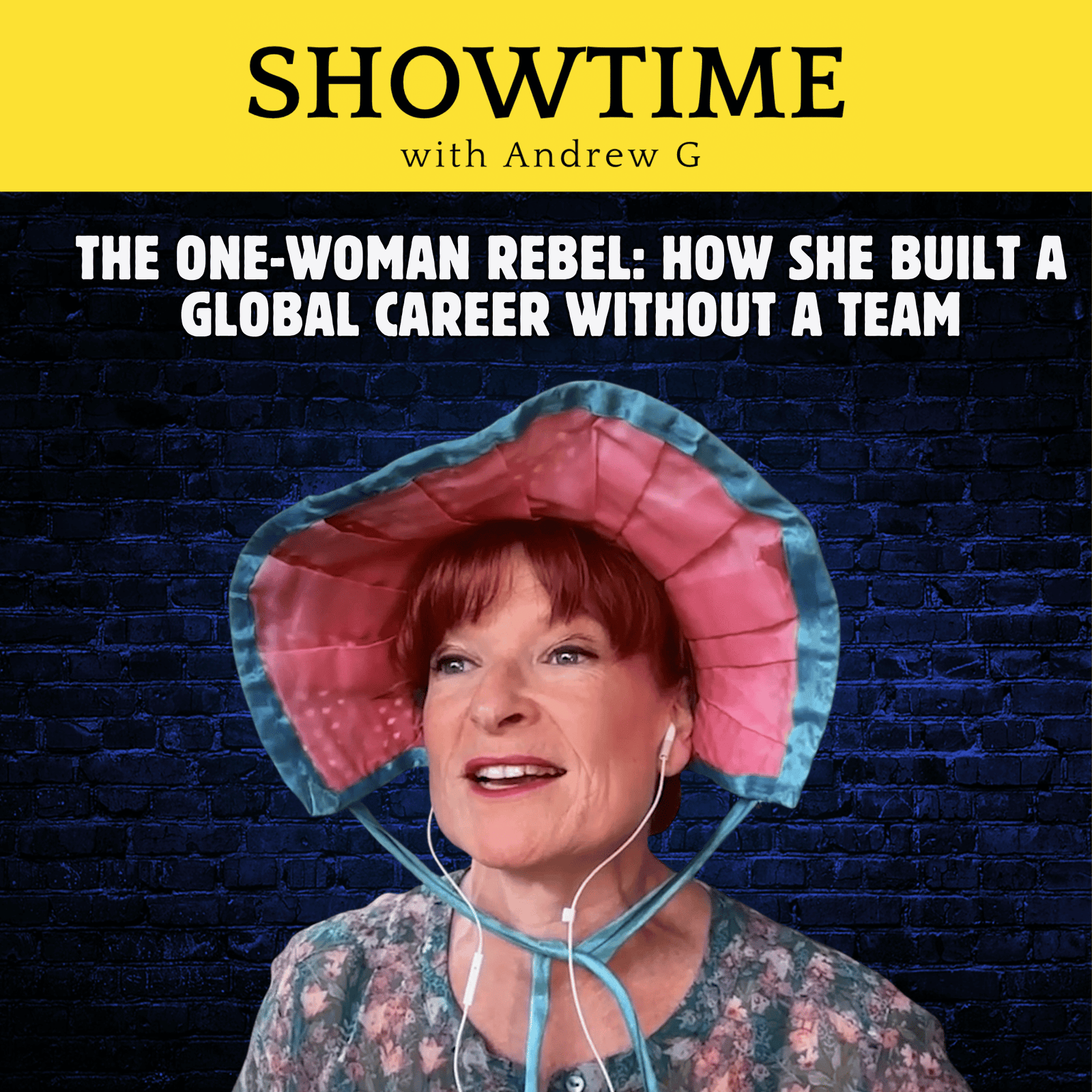
In this episode of Showtime, Andrew G sits down with Penny Ashton, a one-woman show powerhouse who has built an international career through sheer persistence, creativity, and an unwavering love for the stage. What starts as a conversation about theatre quickly unfolds into something deeper: a reflection on independence, rejection, storytelling, and what it really takes to sustain a creative life on your own terms.
For Penny, performing wasn’t a decision—it was instinct. From the age of four, she was already on stage, chasing the thrill of an audience’s reaction. That early moment—accidentally knocking over a prop and getting a huge laugh—was enough. Not because it was perfect, but because it revealed something essential: audiences respond to honesty, even in chaos. That idea would quietly shape everything that followed.
What makes Penny’s journey particularly compelling is how self-built it is. There’s no traditional structure behind her success. No manager. No agent. No large production team. Instead, she became all of those things herself. Writing, producing, marketing, performing—every part of the process runs through her. It’s not glamorous, and it’s rarely easy, but it’s given her something many creatives struggle to find: control.
And that control didn’t come without resistance.
Like many in the arts, Penny faced rejection at almost every stage of her career. Funding applications turned down. Opportunities closed off. Systems that didn’t quite have space for the kind of work she wanted to create. But instead of waiting for permission, she took a different approach—she built her own platform. Show by show, audience by audience, she carved out a space where her work could exist.
That same mindset extends beyond performance. Her story about applying multiple times to become a wedding celebrant isn’t just a side note—it’s a pattern. Persistence isn’t something she talks about in theory. It’s something she’s practiced repeatedly, often out of necessity. If the door didn’t open, she found another way in.
At the center of her work is Promise and Promiscuity, a fast-paced, one-woman show inspired by the world of Jane Austen. On the surface, it’s playful, chaotic, and full of humor. But underneath, it taps into something much more enduring. Austen’s stories have always been about more than romance. They’re about security. Stability. The tension between love and survival.
And that’s exactly why they still resonate.
No matter how much the world changes, those underlying desires remain the same. People want connection, but they also want certainty. They want love, but they also want to feel safe. Penny leans into that duality, using comedy and storytelling to highlight just how little—and how much—has changed over time.
But what truly sets her work apart isn’t just the writing. It’s the way it lives and breathes in front of an audience.
Every performance is different. Every crowd brings its own energy. Some nights are electric, others are quiet, and occasionally, things go completely off-script. There are stories of unexpected audience reactions, technical mishaps, even moments where everything could have fallen apart. But instead of avoiding those moments, Penny embraces them. Because in live theatre, imperfection isn’t a flaw—it’s part of the experience.
That’s also why she’s stayed committed to the stage, even when other paths were available. Screen work, by comparison, feels distant. Controlled. Repetitive. On stage, everything happens in real time. The laughter is immediate. The silence is real. The connection is undeniable.
And that connection comes at a cost.
Touring, for example, isn’t the romantic, free-flowing experience people often imagine. It’s physically demanding, financially uncertain, and logistically complex. Moving from one venue to another, constantly adapting to new spaces, new audiences, new conditions—it requires a level of resilience that often goes unseen. There’s no consistent routine, no guaranteed outcome, just the ongoing commitment to show up and perform, again and again.
But through all of that, one thing remains constant: the audience.
Because at its core, Penny’s work isn’t about scale or spectacle. It’s about connection. The shared experience of being in a room together, reacting to the same story, the same moment, at the same time. It’s fleeting, but it’s powerful.
Beyond theatre, the conversation opens into something broader—a reflection on what it means to build a creative life without a safety net. The balance between passion and practicality. The reality that success doesn’t always look the way people expect it to. And the understanding that sometimes, the most sustainable path forward is the one you create yourself.
At its heart, this episode isn’t just about performance.
It’s about persistence.
About continuing to show up, even when the outcome is uncertain. About choosing independence, even when it’s harder. About finding meaning not just in the big moments, but in the repetition—the thousands of shows, the countless audiences, the small, consistent steps that build something lasting over time.
Because sometimes, success isn’t a single breakthrough.
Sometimes, it’s showing up—again and again—until the world finally catches up.
