

There’s something quietly powerful about a creative admitting that their path wasn’t driven by certainty—but by moments of validation, curiosity, and the people around them. It removes the illusion of having it all figured out and replaces it with something far more real. Not a perfectly planned journey, but one shaped by instinct, experience, and the gradual courage to believe in yourself.
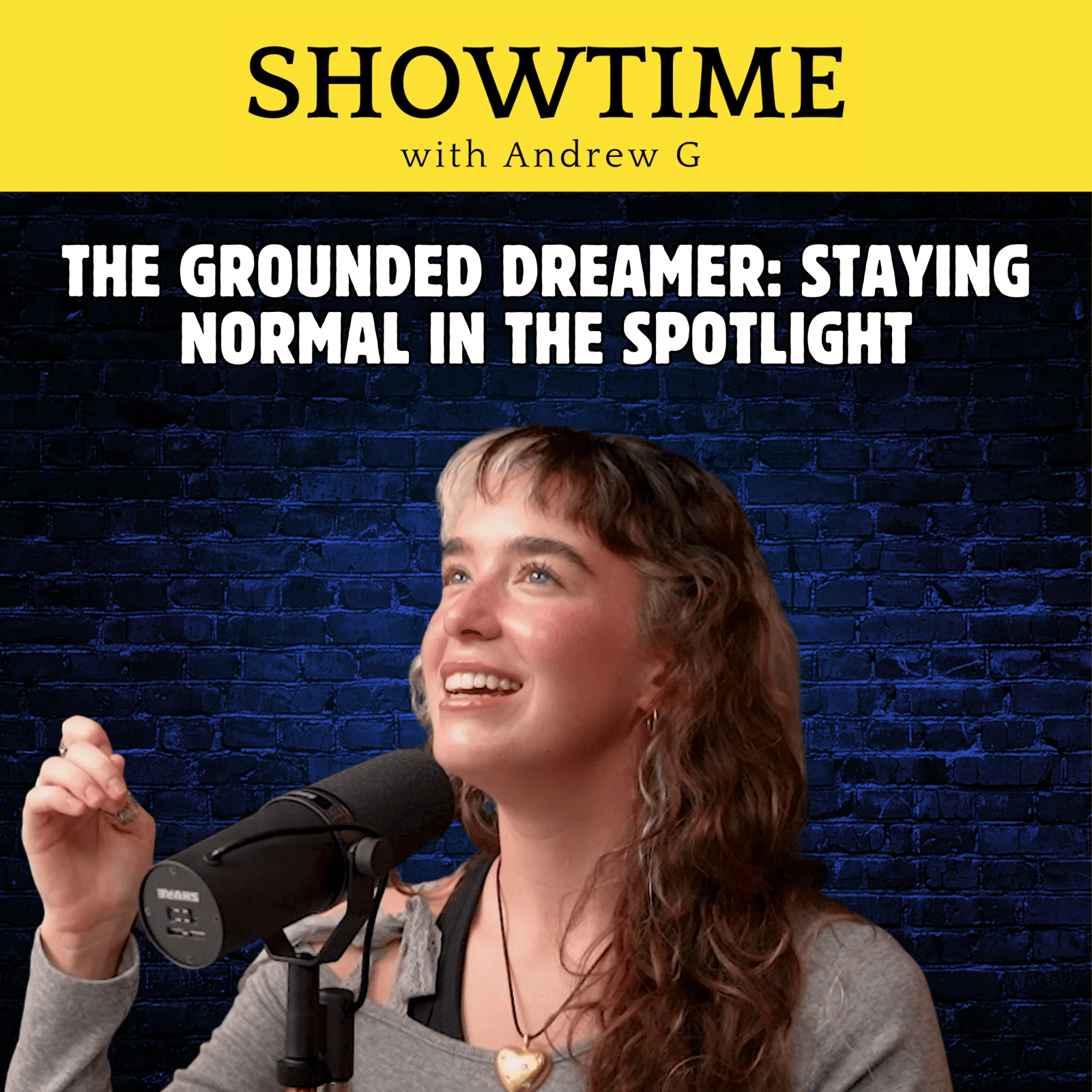
In this episode of Showtime, Andrew G sits down with Sian Fuller, a multi-instrumentalist, songwriter, and performer whose story began long before national television—but was undeniably shaped by it. Known to many from The Voice, where she reached the semifinals at just 16, Sian’s journey goes far beyond early recognition. It’s a reflection of what it means to grow up in the spotlight while still figuring out who you are.
What stands out immediately is how deeply rooted her connection to music has always been. Growing up in a family of musicians and storytellers, creativity wasn’t something she had to search for—it was already there. It was part of her environment, her upbringing, her everyday life. Being surrounded by like-minded, creative people didn’t just inspire her—it normalized the idea that making music and telling stories was something you could pursue seriously.
But like many creative journeys, that early passion didn’t come with instant clarity. There was a moment—around the time she joined The Voice—where she found herself questioning whether music was something she wanted to pursue professionally or simply keep as something she loved. And it’s in that uncertainty that something shifted. Not necessarily confidence, but validation. The realization that people connected with what she was doing gave her the push she didn’t know she needed.
That idea of validation is something many creatives quietly relate to, even if it’s rarely acknowledged. We often talk about self-belief as if it exists in isolation, but Sian’s experience highlights how external affirmation can play a role in shaping internal confidence—especially at a young age. It doesn’t replace self-belief, but it can spark it.
Of course, that kind of exposure comes with its own complexity. Being 16 and suddenly visible to a wide audience isn’t something you can fully prepare for. The experience was fast-paced, intense, and at times overwhelming. There’s a version of yourself that becomes public—permanent, searchable, and open to opinion. And navigating that while still going to school, still growing up, still figuring things out, adds a layer of pressure that’s hard to articulate unless you’ve lived it.
What’s interesting is how Sian reflects on that period not as something purely negative or overwhelming, but as something she’s learned from. There’s an awareness that while no one is truly ready for that level of exposure at that age, it still shaped her in meaningful ways. It taught her about resilience, about boundaries, and about the importance of stepping back when needed.
And that sense of stepping back becomes a recurring theme.
Rather than rushing to capitalize on her exposure, she chose to take her time. To not immediately chase the idea of “making it,” but instead figure out what she actually wanted. That decision alone challenges a common narrative in the entertainment industry—that momentum must always be maximized, that visibility should always be converted into output. Sian’s approach suggests something different. That sometimes, growth happens in the quieter moments, away from the spotlight.
That perspective carries into her return to musical theatre through Once, a production that feels deeply aligned with where she is now. Unlike large, traditional musicals, Once is intimate, raw, and grounded in realism. There’s no separation between performer and musician—the cast does it all. Acting, singing, playing instruments. It requires a level of presence and connection that goes beyond performance and into something more collaborative and human.
For Sian, that’s part of what makes it so compelling.
There’s a kind of honesty in the show that mirrors her own approach to creativity. It doesn’t rely on perfection or spectacle. In fact, part of its beauty comes from the imperfections—the small, human moments that make it feel real. That idea challenges the pressure many performers feel to deliver something flawless. Instead, it suggests that authenticity is often more powerful than precision.
And that shift—from perfection to presence—is something Sian seems to be embracing more fully now.
There’s less focus on proving something, and more focus on experiencing it. On being connected to the people around her, to the story being told, and to the moment itself. It’s a perspective shaped not just by her time in the spotlight, but by everything that came after it. The decision to study, to explore other interests, to not let one path define her entirely.
Because that’s another layer to her story that stands out—the refusal to be boxed into a single identity.
Despite her success in music, she also pursued a degree in science. Not as a backup plan in the traditional sense, but as something she was genuinely interested in. That choice reflects a broader understanding of creativity—that it doesn’t have to exist in isolation. You can be multiple things at once. You can explore different paths without losing your core identity.
And maybe that’s what this conversation ultimately comes back to.
Not the idea of having one clear direction, but the freedom to evolve. To try things, step back, return, and redefine what success looks like on your own terms.
Because being a creative isn’t about having a perfectly mapped-out journey.
Sometimes it’s about following what feels right, even when it’s uncertain—and trusting that, over time, it will lead you exactly where you need to be.
