

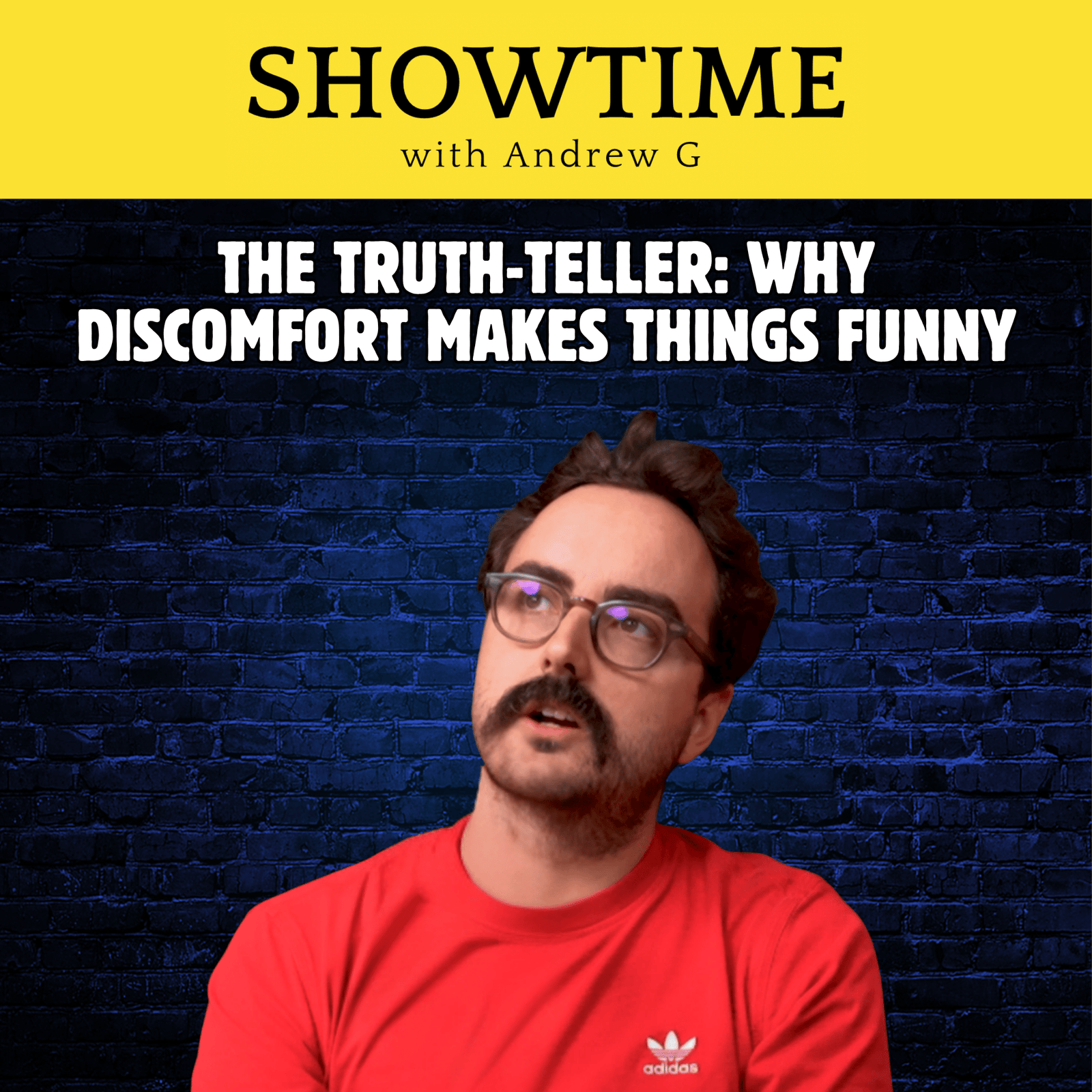
There is something strangely compelling about a comedian who openly admits they are still figuring it out. Not in a self deprecating way, but in a way that feels grounded in reality. Because behind the sharp punchlines and confident stage presence, stand up comedy is far less certain than it looks. It is unpredictable, uncomfortable and often built on moments that do not work before they finally do.
In this episode of Showtime, Andrew G sits down with Daniel Muggleton, one of Australia’s most talked about stand up comedians, known for his fearless material and sharp perspective. But what unfolds is not just a conversation about comedy. It is an honest look at what it actually takes to build a career in stand up, and why the path is rarely as intentional as people think.
Daniel does not describe his journey as a clear decision to pursue comedy. There was no defining moment where everything suddenly made sense. Instead, it was a series of small steps, risks and opportunities that slowly built into something sustainable. From studying law at university to performing at open mics, his path reflects something many creatives experience. You do not always choose the craft. Sometimes you just keep doing the thing that feels closest to you until everything else falls away.
What makes his approach to stand up comedy stand out is his philosophy around humour. For Daniel, comedy is not about finding something that is already funny. It is about taking something that is not funny and making it funny. That shift in perspective changes everything. It moves comedy away from simple storytelling and into something more layered, where tension, discomfort and honesty become the foundation of the joke.
That idea is rooted in something deeper. Growing up, humour was not just entertainment. It was a way of navigating difficult or uncomfortable moments. It was present in conversations that most people would avoid, turning tension into something lighter without ignoring it completely. That instinct followed him onto the stage, shaping a style that is less about easy laughs and more about saying things people might not expect.
But like most stand up comedians, the early years were not easy. Daniel speaks openly about how long it took to actually become good. There is a misconception that comedians step on stage and immediately know how to make people laugh. In reality, stand up comedy is built on failure. Jokes fall flat. Sets do not land. Entire performances can feel like they are going nowhere. And unlike many other creative fields, that feedback happens in real time, in front of a room full of people.
That is what makes stand up unique. You cannot hide behind edits or revisions. You find out instantly whether something works. And more often than not, it does not, at least in the beginning. But that process is where the craft is developed. Every failed joke, every awkward pause, every moment of silence becomes part of the learning curve.
For Daniel, there was no single breakthrough moment that changed everything. Instead, progress came gradually. A recorded set that gained attention. Opportunities to perform in different places. A move to the UK that became a make or break decision. It was not about instant success, but about staying in the process long enough for something to shift.
That idea of persistence is something that runs throughout his story. There are long periods where it feels like nothing is happening, where the effort does not match the outcome. It is easy to question whether it is worth continuing. But in stand up comedy, as in most creative careers, those periods are not a sign to stop. They are part of the path.
Another layer to his perspective is the importance of live performance. In a world where content is constantly consumed online, stand up comedy still holds something that cannot be replicated on a screen. The shared experience of being in a room, reacting in real time, feeling the energy shift as a joke lands or misses, is what defines the craft.
Daniel is clear about this distinction. Online clips and specials can reach millions of people, but they do not fully capture what stand up is meant to be. Comedy, at its core, is a live experience. It is shaped by the audience, the environment and the moment. No two shows are exactly the same, and that unpredictability is what makes it powerful.
That unpredictability also comes with pressure. When people buy tickets, bring friends and invest their time into seeing a show, there is an expectation that it will be worth it. That pressure does not come from trying to outperform previous work, but from wanting to deliver a genuinely good experience for the audience. It is a different kind of responsibility, one that is tied directly to the people in the room.
Despite that, Daniel does not believe in playing it safe. He does not adjust his material based on what he thinks an audience will or will not accept. In fact, he sees that as a mistake. Some of the best reactions come from moments where there is uncertainty, where the outcome is not guaranteed. It is in those moments that comedy feels most real.
At its core, stand up comedy is not just about jokes. It is about perspective. It is about how someone sees the world and how they translate that into something others can connect with. Whether it is through discomfort, honesty or observation, the goal is not perfection. It is recognition.
And maybe that is why people keep coming back to it. Not just the audience, but the performers themselves. Because every now and then, something works. A joke lands exactly how it is meant to. A room responds in a way you cannot predict or control. For a brief moment, everything aligns.
Those moments are rare, but they are enough.
Enough to keep showing up. Enough to keep taking the risk. Enough to step back on stage, even when it does not go to plan.
Because in stand up comedy, as in any creative pursuit, you are not chasing certainty. You are chasing connection. And when it happens, even for a second, it reminds you why it is worth it.
